Ask ten people what mental health means and you’ll get ten different answers. Stress. Therapy. “Staying positive.” None of them are wrong, but none of them tell the whole story either. And that gap in understanding is exactly why so many people ignore their mental health until it starts affecting everything else.
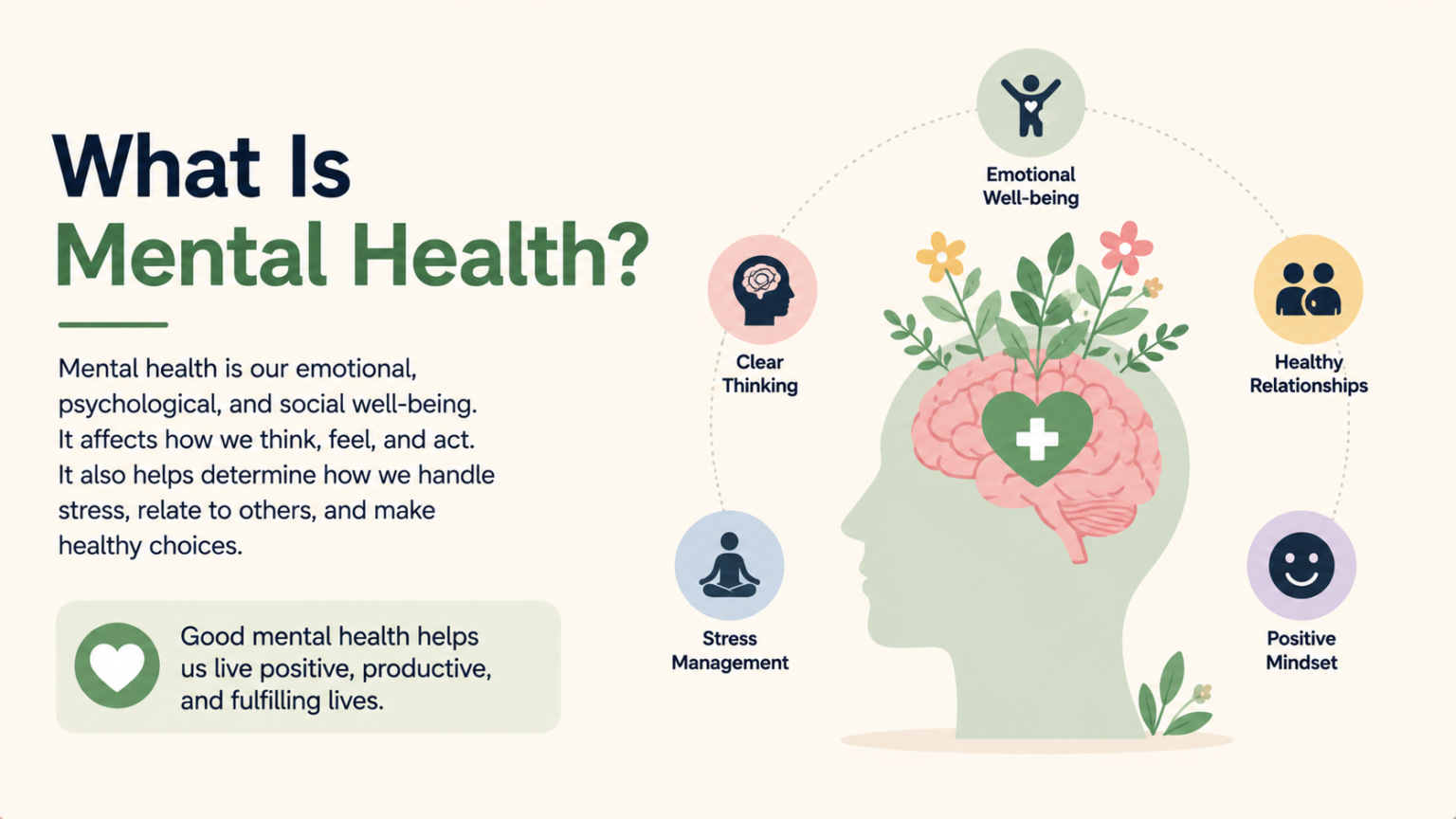
So what is mental health, really? It’s your emotional, psychological, and social wellbeing. It shapes how you think, how you feel, how you handle stress, how you connect with others, and how you make decisions. It’s with you at every stage of life, from childhood through old age, and it influences almost everything you do, whether you notice it or not.
In this article, we’ll break down the mental health definition, what affects it, the signs of poor mental health worth taking seriously, and practical ways to protect it.
Mental Health Definition: More Than the Absence of Illness
Here’s the most common misunderstanding. People assume that if they don’t have a diagnosed condition like depression or anxiety, their mental health must be fine. But mental health works a lot like physical health. You can be free of disease and still be out of shape, run down, or one bad week away from getting sick.
The same logic applies to your mind. Someone with no diagnosis can still be struggling: sleeping poorly, snapping at people they love, feeling flat, running on empty. And someone living with a mental health condition can, with the right support, feel stable, connected, and genuinely well.
So it helps to think of mental health as a spectrum rather than a switch. You’re not simply “healthy” or “unhealthy.” You move along that spectrum throughout your life, sometimes within a single month, depending on what’s happening around you and inside you.
What Good Mental Health Looks Like
Good mental health doesn’t mean being happy all the time. That’s not a realistic goal for anyone, and chasing it usually backfires. Sadness, anger, grief, and worry are normal responses to real situations. Feeling them doesn’t mean something is wrong with you.
Instead, good mental health tends to look like this: you can cope with the normal stresses of life without falling apart. You bounce back from setbacks, even if it takes time. You can build and keep meaningful relationships. You’re able to work, study, or contribute in ways that feel worthwhile. And when hard emotions show up, you can sit with them, process them, and move through them instead of getting stuck.
Notice that none of this requires a perfect life. People with good mental health still lose jobs, go through breakups, and get bad news. The difference is in how they absorb and recover from those hits.
What Affects Your Mental Health
Mental health isn’t shaped by any single thing. It’s the result of several factors interacting over time.
Biology. Genetics, brain chemistry, hormones, and physical health all play a role. If mental health conditions run in your family, your own risk may be higher. Chronic illness, poor sleep, and even gut health can influence how you feel mentally.
Life experiences. Trauma, abuse, neglect, and major losses leave marks, especially in childhood. But positive experiences matter too. Strong early relationships and a sense of safety build resilience that lasts.
Environment and circumstances. Money stress, job insecurity, discrimination, loneliness, and unsafe living conditions all wear on mental health. It’s much harder to feel mentally well when your basic needs are under constant threat. This is why mental health is a social issue, not just a personal one.
Daily habits. Sleep, movement, food, alcohol, screen time, and social connection have a bigger effect than most people expect. None of them is a cure for a serious condition, but they form the foundation everything else rests on.
Signs Of Poor Mental Health To Watch For
Everyone has rough patches. The question is when a rough patch becomes something that needs attention. A few signs worth taking seriously:
The difficulty lasts for weeks rather than days. It interferes with work, relationships, or daily functioning. You’re withdrawing from people and activities you used to enjoy. Your sleep or appetite has changed significantly. Or you’re leaning on alcohol or other substances to cope.
Mental health conditions are common. The World Health Organization estimates that roughly one in eight people worldwide lives with a mental disorder, with anxiety and depression being the most widespread. Common doesn’t mean trivial, but it should tell you something important: if you’re struggling, you’re not unusual, you’re not weak, and you’re not alone.
These conditions are also treatable. Therapy, medication, lifestyle changes, and social support all work, often in combination. Most people who get appropriate help see real improvement. The biggest obstacle usually isn’t the condition itself. It’s the delay in asking for help, often caused by stigma or the belief that you should be able to handle everything on your own.
How To Improve Your Mental Health
You don’t need to wait for a crisis to take care of your mental health, the same way you don’t wait for a heart attack to start eating better. A few habits consistently help:
Protect your sleep. Almost nothing degrades mental health faster than chronic sleep deprivation.
Stay connected. Reach out to people even when you don’t feel like it. Isolation feeds most mental health problems.
Move your body. Regular exercise has a well-documented effect on mood and anxiety, even something as simple as daily walks.
Know your warning signs. Irritability, numbness, procrastination, insomnia. Learn what “struggling” looks like for you specifically, so you can catch it early.
Talk before things pile up. Share what you’re going through with someone you trust, and if it feels heavier than you can manage alone, reach out to a doctor, therapist, or mental health helpline. Asking for help is a practical decision, not an admission of failure.
Why Mental Health Matters
Mental health is not a luxury or a soft topic. It’s the foundation for everything else: your relationships, your work, your physical health, your ability to enjoy your own life. It moves along a spectrum, it’s shaped by biology and circumstance and habit, and it can be strengthened and repaired at any point.
You don’t have to feel great all the time to be mentally healthy. You just need to be able to face what life throws at you, recover, and keep going. And when you can’t do that alone, help exists, and it works.
FAQs About Mental Health
What is mental health in simple words? Mental health is how you think, feel, and cope with everyday life. It covers your emotional, psychological, and social wellbeing.
Is mental health the same as mental illness? No. Mental illness refers to diagnosable conditions like depression or anxiety. Mental health is broader and applies to everyone, whether or not they have a condition.
What are common signs of poor mental health? Persistent low mood, withdrawing from people, changes in sleep or appetite, trouble functioning at work or home, and relying on substances to cope.
Can mental health improve? Yes. With support, treatment, and healthy habits, mental health can improve at any stage of life, even for people with long-standing conditions.